HF Motion
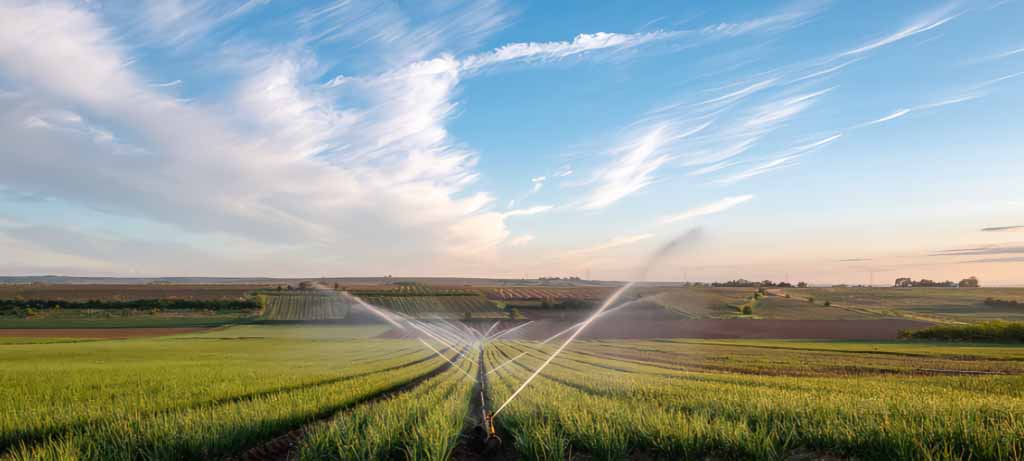
Agricultural irrigation is to provide water sources to farmland so that farmland can be supplied with water at the right time, in the right quantity, and in moderation to meet the growth needs of plants, especially in arid or semi-arid areas or during dry seasons. Agricultural irrigation aims to ensure that crops receive sufficient water to increase yields and improve quality. This typically involves transporting water from a source (such as a river, lake, well, reservoir, etc.) to the roots of the soil in agricultural fields to make up for a lack of precipitation. Irrigation can enable a certain unit area of farmland to obtain higher crop products and quality. It can also help improve soil quality and reduce soil salt accumulation and soil erosion.

The necessity and role of agricultural irrigation:
- Insufficient precipitation: In some areas, precipitation is unevenly distributed, or the amount of precipitation is not enough to meet the growth needs of crops. In these areas, agricultural irrigation is necessary to make up for insufficient rainfall and ensure that crops receive sufficient water.
- Increase yield: Timely agricultural irrigation can provide just the right amount of water to promote the growth of crops, increase yield and improve quality. This is critical to achieving food security and agricultural economies.
- Drought management: In arid areas, agricultural irrigation can provide necessary water sources during dry seasons to support agricultural production. This helps mitigate the negative impact of drought on agriculture.
- Multiple crops: In some areas, farmers need to grow multiple crops to meet market demand. Irrigation can help them grow crops during dry or non-precipitation seasons.
- Improve soil quality: Agricultural irrigation helps improve soil quality and reduce soil salinization and soil erosion problems. The right amount of water helps maintain soil fertility and structure.
- Increase agricultural diversity: Irrigation can expand the diversity of agriculture, allowing farmers to grow a wider range of crops, including high-value crops, thus increasing the diversity of the agricultural economy.
- Address climate change: Climate change is leading to erratic precipitation patterns and more frequent drought and flood events. Agricultural irrigation can help farmers cope with these uncertainties and reduce crop risks.
- Increase agricultural sustainability: Through scientific management and the application of modern technology, agricultural irrigation can improve the utilization efficiency of water resources, reduce waste, and help maintain the sustainability of water resources.
Irrigation Energy Costs and Emissions
Irrigation usually requires water pumps, water delivery systems, clean water sources, energy sources, etc. Among the long-term operating costs, the energy consumption cost of irrigation needs to be focused on. Taking South America as an example, for planting soybeans on 1 acre of land, the annual electricity cost for irrigation is as follows:
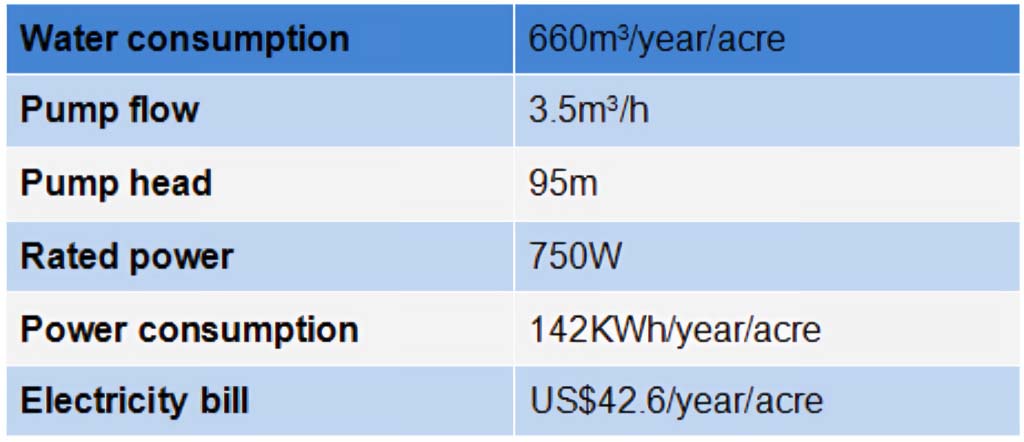
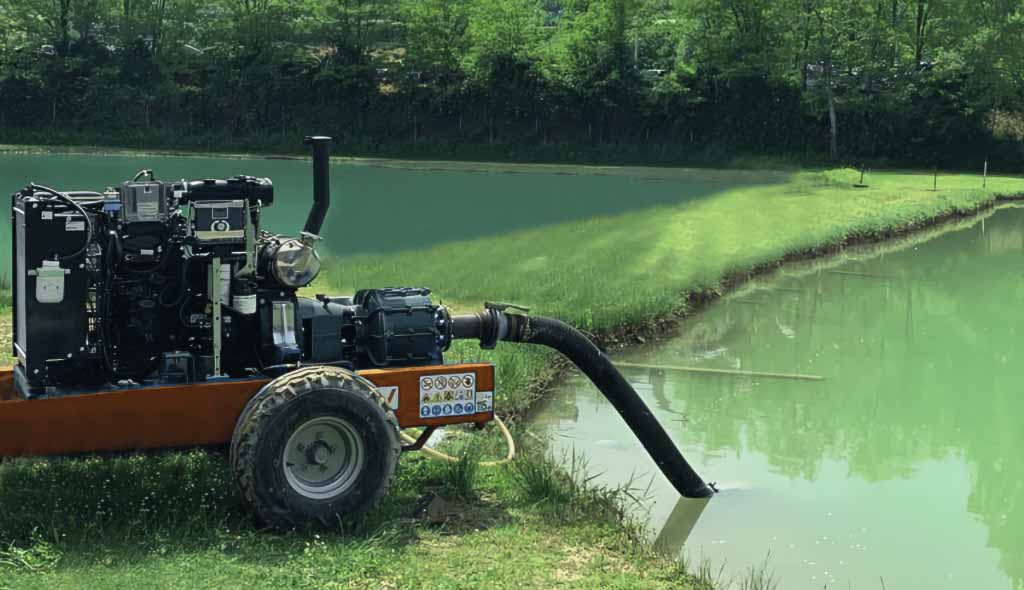
When the farm area reaches 100 acres, the annual electricity cost for irrigation is US$4,260. This is the cost when the local power is stable. If there is no power supply, a diesel engine-driven water pump is needed for irrigation. For the same 100 acres of irrigation water, 4,260L of diesel is consumed every year, and the cost of irrigation fuel will reach US$5,200.
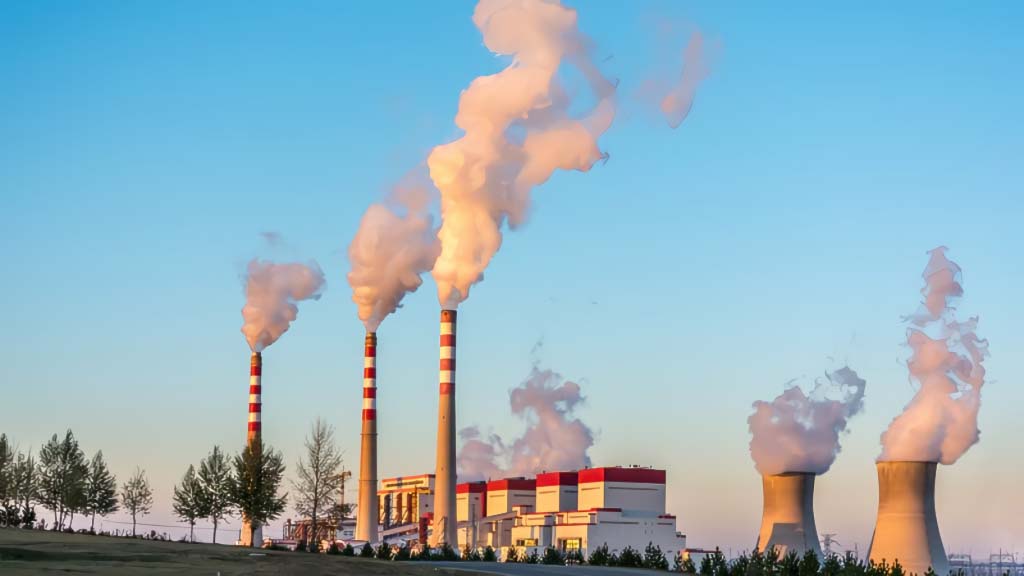
Currently, thermal power generation still accounts for more than 60% of the world’s total power generation. Thermal power generation produces 870g of CO2 per KWH. The corresponding electricity consumption for annual irrigation of 100 acres of land will produce 12.35 tons of CO2 and various pollutants.
If the water pump is driven by a diesel engine, the CO2 emissions from complete combustion of 4,260L diesel is 11.1 tons, and it also emits 14.6kg of sulfur dioxide, 189kg of nitrogen oxides, and 44.3kg of soot.
Traditional Solar Pump Irrigation
Advantages
If all or part of the electricity or fuel used for irrigation of 100 acres of land is replaced by solar power, the above situation will be greatly improved:
- Cost reduction: As a renewable energy source, solar energy has low fuel costs. Once the solar system is put into use, solar energy is almost free. This can significantly reduce the energy costs of irrigation;
- Environmentally friendly: Solar power generation does not produce greenhouse gases and pollutants, helps reduce the impact of climate change, and is of great significance to environmental protection;
- Ecological maintenance: Solar energy is a sustainable energy source that will not be exhausted and reduces dependence on limited natural resources, which helps maintain the stability and sustainability of the ecosystem;
- Energy independence: Farms that use solar energy can reduce dependence on external power supplies and increase energy independence, especially in remote areas;
- Intelligent integration: Solar irrigation systems can be integrated with intelligent control technology to automatically adjust irrigation according to plant needs, meteorological conditions and soil moisture to improve efficiency;
- Lower Investment: After the initial investment in a solar system, long-term operating costs are usually lower over time. In addition, financial incentives and subsidies provided by governments and institutions for related solar projects can be used to further reduce investment.

Disadvantages
From the time of invention to the present, traditional solar power generation solutions have been constantly updated in technology, but still have fundamental flaws. This problem comes from unstable sunlight. In the morning, evening, and cloudy days, the sunlight intensity is not enough and the solar power generation is small, which will bring about a series of problems:
- The water pump cannot be started. There is sunlight but cannot be used, and the energy utilization rate is low;
- If the number of solar panels is increased to meet the water pump operation under low sunlight intensity, the total investment will be greatly increased;
- There are solar pumps on the market with AC power/solar switching mode, which automatically switch to AC power operation when the solar power is low. However, solar energy cannot be used at this time and the energy utilization rate is low.
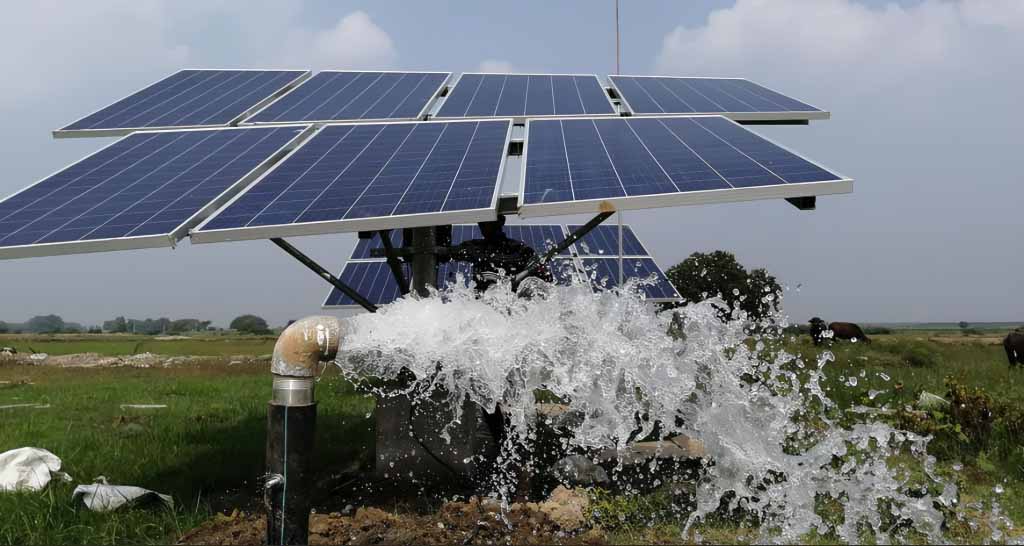
E-Hybrid Solar Drive Solution for Irrigation Pump
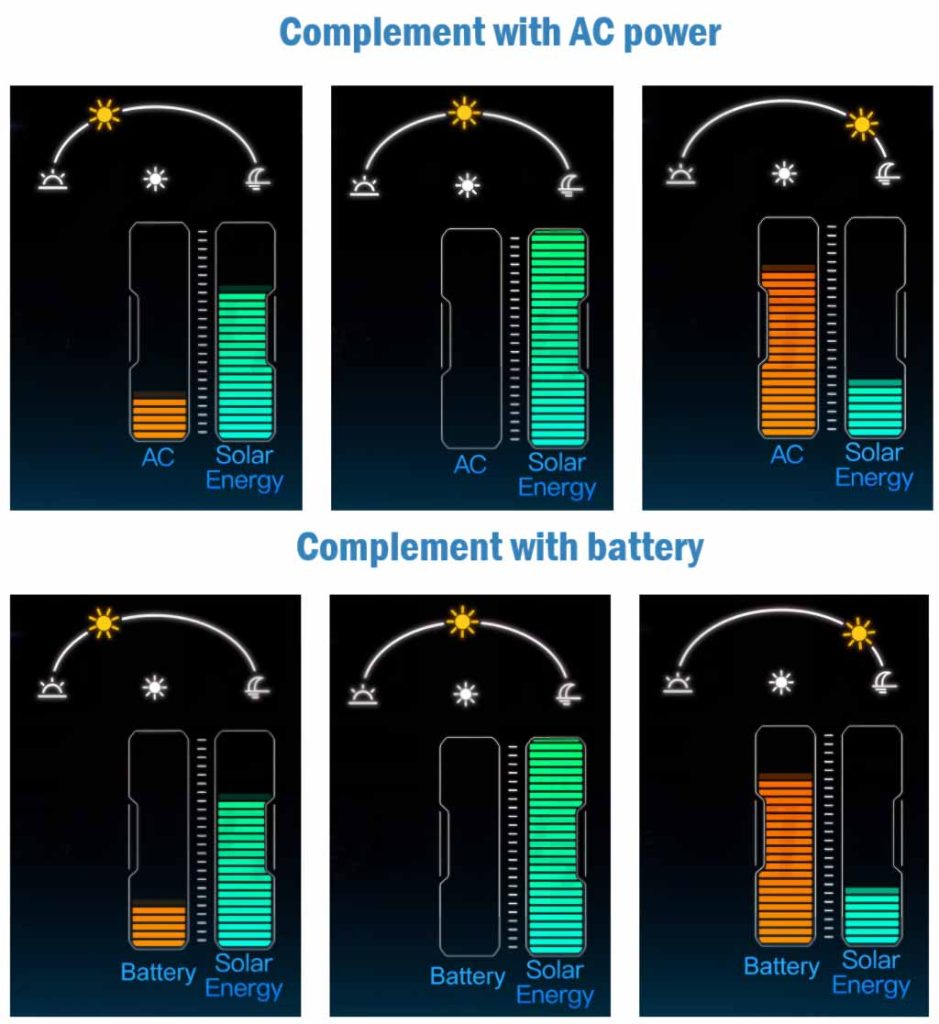
HF Motion already has a complete solution to the problems of traditional solar pumps. E-Hybrid technology can meet the parallel input of solar energy and AC power and complement each other in real time. It can also be used with a backup battery to participate in the complementation.
It has the following characteristics:
- Sufficient solar power will directly drive the pump, excess power will charge the backup battery.
- Insufficient solar power will directly drive the pump, AC power will supplement the missing part.
- When there is no AC power, and not enough sunlight, insufficient solar power will directly drive the pump, battery will supplement the missing part.
- AC power and battery supplement based on the real-time solar power generation and consumption of the pump.
- When pumps are not running, solar power will only charge the battery.
- Battery no output under sufficient Solar power or stable AC power.
- No matter how the solar power changes, the total output power is stable and relevant to the consumption of the applications.
- In case when there is no AC power and battery is low in the daytime, the motor controller allow low speed operation under insufficient solar power.
- Even if the Solar power is only 1w, still can be used by applications.
- E-Hybrid tech module, MPPT module, motor controller are integrated design, to reduce the installation costs and power lose.
Combined with E-Hybrid technology, HF Motion has launched a variety of solutions and products for agricultural irrigation pumps:
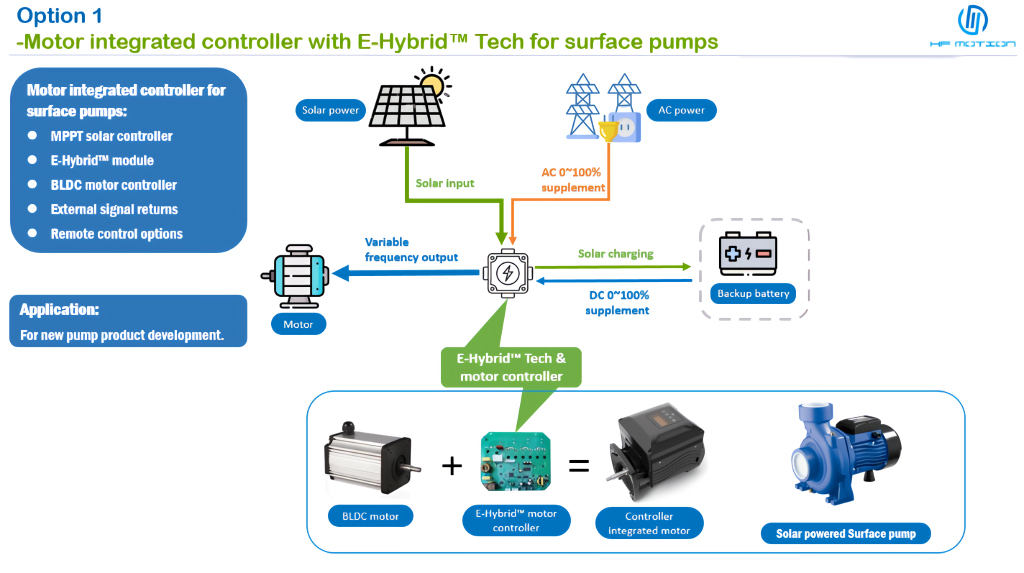
Option 1
Solution: Surface pump with controller integrated BLDC motor, controller integrated with E-Hybrid tech.
Products: BLDC motor/controller/controller integrated motor/complete pump with motor & controller
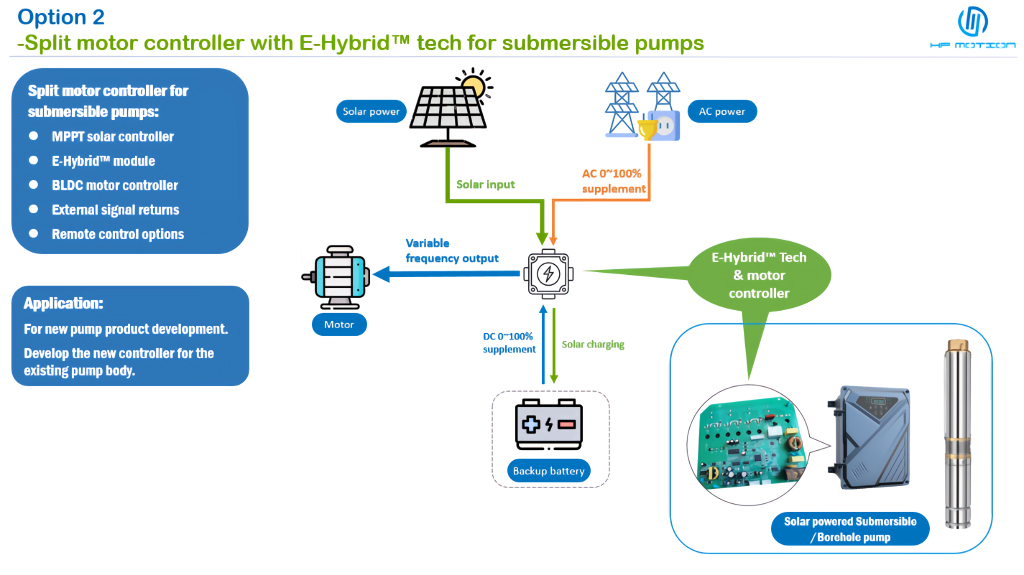
Option 2
Solution: Submersible pump with BLDC motor, and split controller integrated with E-Hybrid tech.
Products: BLDC motor/controller/complete pump with motor & controller
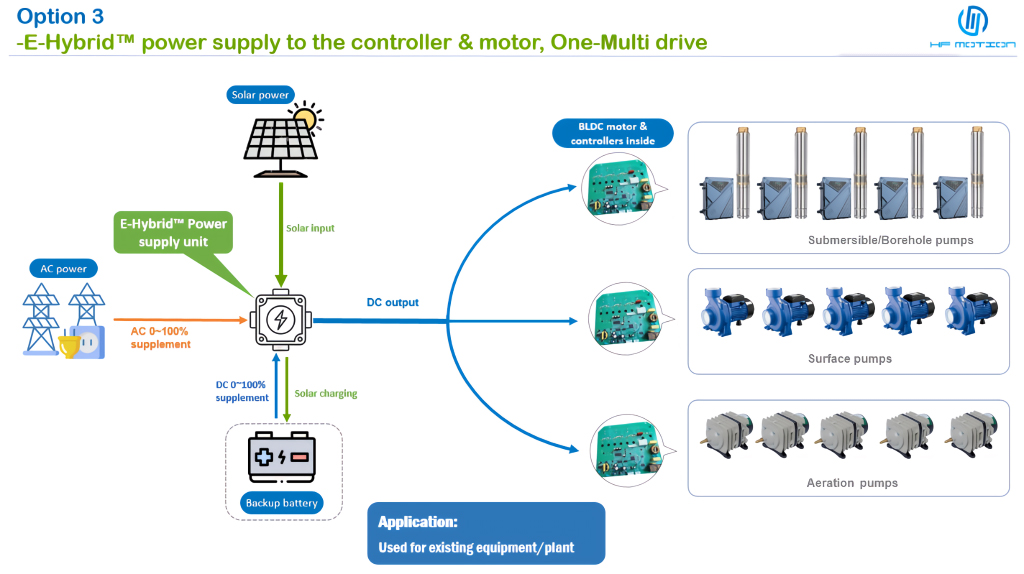
Option 3
Solution: E-Hybrid power supply unit for pumps, One-multi drive.
Product: E-Hybrid power supply 2.2~30KW.
Conclusion
When considering solar pump systems for agricultural irrigation, the main goal is to reduce energy consumption and operating costs. The application of E-Hybrid technology can reduce energy consumption costs by 30% again based on traditional solar pumps. Against this background, the introduction of E-Hybrid technology is an important development that is expected to significantly improve the performance and economic benefits of the system.
It is a promising technological innovation for agricultural irrigation that can significantly improve system viability and reduce operating costs, while also having a positive impact on the environment and resource management. Helps create distributed energy systems, which generate electricity in small-scale, off-grid or remote areas, making irrigation easier. This can indirectly increase crop yields and promote the sustainable development of agriculture in energy-scarce areas.