 HF Motion
Trends in Solar Industry
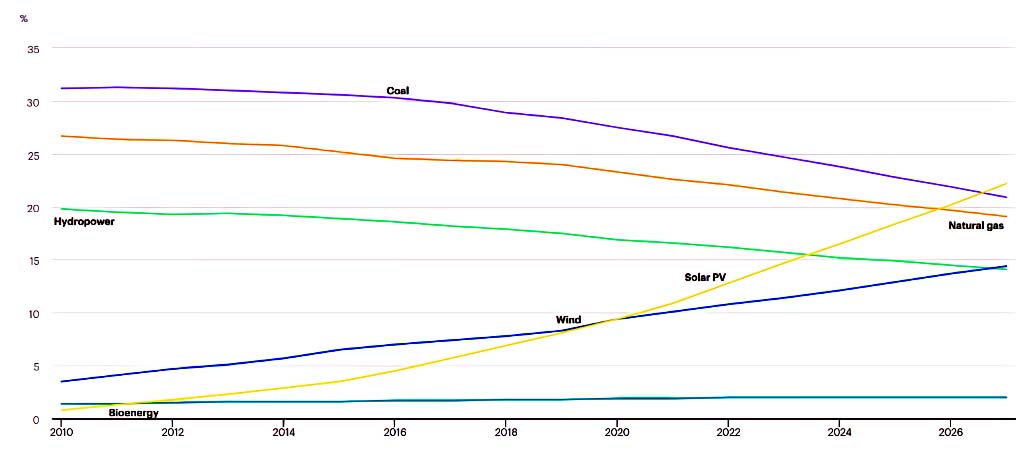
Solar PV’s installed power capacity is poised to surpass that of coal by 2027, becoming the largest in the world. Cumulative solar PV capacity almost triples in our forecast, growing by almost 1 500 GW over the period, exceeding natural gas by 2026 and coal by 2027. Annual solar PV capacity additions increase every year for the next five years.
Utility-scale solar PV is the least costly option for new electricity generation in a significant majority of countries worldwide. Distributed solar PV, such as rooftop solar on buildings, is also set for faster growth. Solar power system typically an attractive investment for homeowners who pay high electricity prices, have roofs with decent sun exposure, want to reduce their environmental impacts, and want to save for more than 50% of electricity bills.
Among them, home off-grid and on-off grid applications also account for the main part. As technology advances and costs fall, many households are turning their energy solutions to solar power system. This means that not only can they generate energy self-sufficiently, but they can also store excess energy for emergencies. This trend is especially evident in remote areas or communities that want to be more independent. Through photovoltaic technology, they can not only lower their energy bills but also contribute more to the environment.
Major Types of Solar Inverters
When classifying solar inverters, it usually involves their differences in system connections and functionality. In home solar systems, there are three main types of solar inverters:
On/off-grid Inverter
Suitable for solar systems connected to the grid. Convert the DC power generated by solar panels into AC power and deliver it to the household power system. When there is no load, the electricity generated by solar energy will be transmitted to the power grid, and the power supply will be calculated by the electricity meter to offset the electricity cost or obtain power generation revenue. When there is no power output from solar energy, the grid supplies power to the loads.

Off-grid Inverter
For use in stand-alone systems, solar systems not connected to the public grid. Converts the DC power produced by solar panels into AC power that can be used by devices in home or commercial. Off-grid inverters are often used in conjunction with battery storage systems to provide power when solar power is unavailable.

Hybrid Inverter
This inverter has the functionality of both grid-tied and off-grid systems. The ability to draw energy from solar panels, battery storage systems or the grid and adjust the direction of energy according to demand to ensure that the system can always supply power. When there is no load, the electricity generated by solar energy can also be supplied to the grid. Hybrid inverters are typically used in environments where flexibility in response to energy demands and unstable grid conditions is required.

Each of these different types of inverters is suitable for a different solar system, depending on the needs of the system owner and the available infrastructure. Choosing the right inverter type can maximize the efficiency and reliability of your solar system.
Shortcomings of Existing Mainstream Solar Technology
The shortcomings of existing mainstream solar energy technology are mainly due to the fact that sunlight is unstable. The light intensity changes throughout the day, and also due to weather changes. Even if the solar system is equipped with batteries, and uses a hybrid mode for peak shaving and valley filling, it is still not an ideal solution. The main problems are as follows:
- The cost of energy storage products is very high, and if it is frequently charged and discharged, its service life will be shortened, the cost to replace the battery is also very high, and the payback time is long;

2.When the solar power is insufficient and the battery is out of power, it can only switch to AC to drive the loads, such as in the morning, evening, or cloudy days. Solar energy cannot be utilized at this time;

3. In places where there is no mains power and continuous raining for days, the off-grid system cannot work;

The investment is high and the return time is long. The cost of an overall solar system with energy storage is very high, and it usually takes 6-7 years for a home system to recover its investment;
In a hybrid inverter system, when the solar power is low, it must be stored by the battery to be utilized, so the battery life is shorter.
E-Hybrid tech:Unique solar technology
The instability of solar energy is an unchangeable natural law, so how to improve and compensate for this problem in solar power generation systems? There are two main considerations: whether the solar power can be directly used to drive the load when the solar power is low, and whether other energy sources can be used to supplement the solar energy so that the load can still operate at the rated power.
In E-Hybrid technology, these two problems have been completely solved:
- When the Solar power is higher than loads, solar power drive the loads directly. And excess power charge the battery.
- When there are no loads, solar power will only charge the battery.
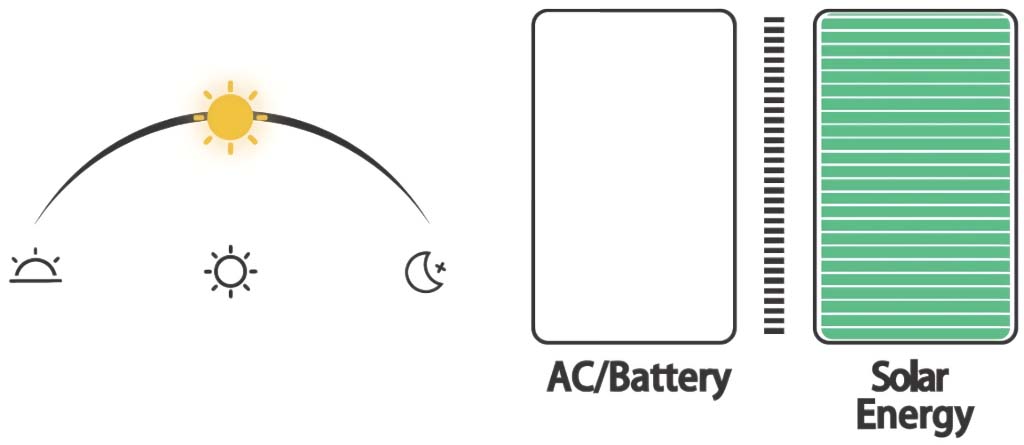
- When the Solar power is insufficient, AC power or Battery will join in and supplement the missing part of power, 0~100% real-time complement.


In the E-Hybrid solar power system, the solar power directly outputting from sunrise to sunset. And excess solar power will charge the battery.
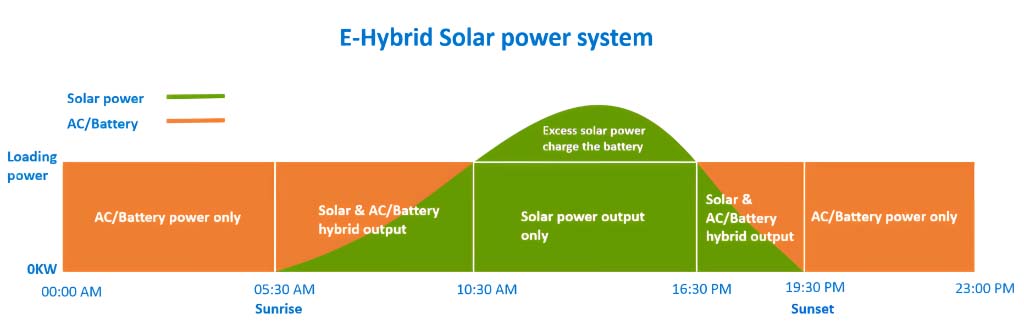
In the traditional solar power system, the solar power directly outputting only when it is reaching to the loading power.

As a result, the solar power utilization rate is a big difference.

E-Hybrid Solar Power Products and Applications
AC power supply


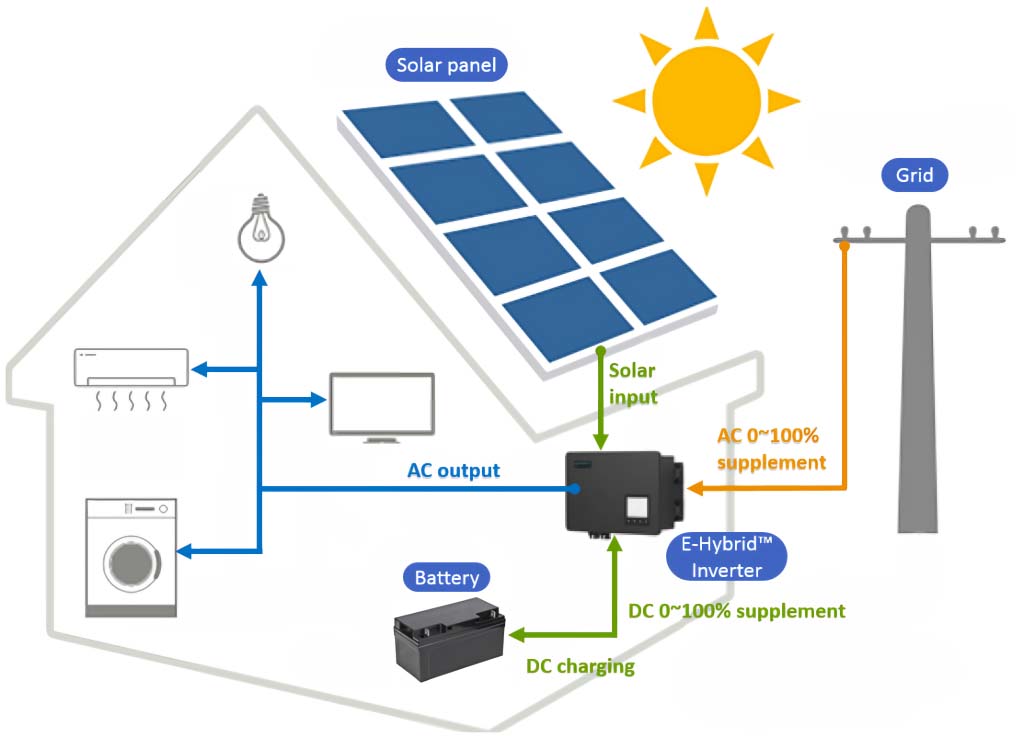
AC output power supply products are mainly used for household power systems and areas without power grids. The output is 220V or 110V AC power. The applications are as follows:

DC power supply


In addition to household AC applications, another important field of E-Hybrid tech is DC applications, including household DC appliances like solar fan, solar air conditioner, solar refrigerator, etc. Also major commercial and industrial equipment applications. DC systems are more efficient and have lower equipment costs than AC systems.
Low-voltage DC power supply, solar and battery input available, input and output are 24/48/60VDC.
High voltage DC power supply, input is 350V solar and 220/380VAC, output is 350VDC.
DC output power supplies are mainly used in commercial and industrial applications, as well as household DC appliances. They are directly output to equipment with BLDC motors, eliminating the process of converting AC to DC and reducing energy loss.
Its application is as follows:

E-Hybrid technology and products solve some crucial problems in current solar applications, such as the inability of solar systems to maintain stable output in areas without electricity, battery capacity reduced too quickly, and high replacement costs. And how to fully utilize solar energy in areas with electricity to further reduce electricity bills and extend battery life. Smaller energy storage can also be configured to reduce investment and equipment replacement costs.
If there is a possibility of 1% improvement in efficiency, HF Motion will spare no effort to develop and implement relevant solutions, and finally provide users with valuable products. HF Motion’s solution is committed to allowing everyone in the world to have access to electricity, and no longer suffer from power outages.